
Welcome to the research group page of UNTRAPHOB!
Click here to read a summary of the project that is funded by the Hellenic Foundation for Research and Innovation 
Meet Our Team!
We are proud to present our dedicated and talented team that made this program a success.
- Maria Petropoulou (PI)
- Stavros Dimitrakoudis
(NKUA Postdoctoral research associate)
- Stamatios Ilias Stathopoulos
(NKUA PhD candidate Postdoctoral research fellow @ DESY, Zeuthen)
- Despina Karavola
(NKUA PhD candidate)
- Margaritis Chatzis
(NKUA MSc student PhD candidate @ Potsdam University)
What are we studying?
- Particle acceleration mechanisms in extreme astrophysical environments
- High-energy photon, charged particle, and neutrino production mechanisms
- Multi-messenger models for astrophysical jets
- Code development (https://github.com/mariapetro/LeHaMoC)
Deliverables
The main scientific deliverables of UNTRAPHOB cover both the development of theoretical and computational tools and their application to observational and simulated data. Specifically, the deliverables include:
- Master’s thesis on the development and parametric study of a new lepto-hadronic emission model for blazars based on Bethe–Heitler physics (link)
- Construction of an empirical function for the Bethe–Heitler pair-production spectrum, significantly accelerating numerical computations (link)
- Article on variability studies within leptonic models for blazars (link)
- Article on variability studies within hadronic models for blazars (link)
- Master’s thesis on simulations of gamma-ray light-curves and spectra for CTAO (link)
- Article on simulations of gamma-ray light-curves and spectra for CTAO (link)
- Article on the development of LeHaMoC, a new open-source lepto-hadronic code and statistical fitting using MCMC (link)
- Article on applying the new tool to observational data (link)
- PhD dissertation on blazar variability in the context of lepto-hadronic radiation models (link)
- Open-source MCMC fitting software based on the lepto-hadronic code LeHaMoC (link)
Beyond the planned deliverables, the project led to 22 additional scientific publications arising from collaborations, methodological developments, and exploratory analyses, significantly enhancing the program’s scientific impact. Two exemplary publications, which were not part of the original plan but emerged organically from the research, include:
- A scientific article on the temporal and spectral signatures of magnetic reconnection near the supermassive black hole of an active galaxy (link)
- A scientific article on the temporal and spectral signatures of magnetic reconnection at larger distances from the black hole, within the plasma jet (link)
These articles provide theoretical predictions that can be observationally tested and contribute to answering the fundamental question of how and where particles responsible for non-thermal radiation in active galaxies are accelerated. Although not included in the initial deliverables, they constitute significant high-value scientific results of the project.
Program highlights
- A closer look at Bethe-Heitler pair production process in blazars
- LeHaMoC: an open-source leptohadronic radiation code
- Leptonic blazar variability: the case of Mrk 421
- Leptohadronic blazar variability: the case of Mrk 501
“Engage and Learn: Group Activity and Workshops”
- GammaPy Workshop: Python for gamma-ray astronomy bootcamp
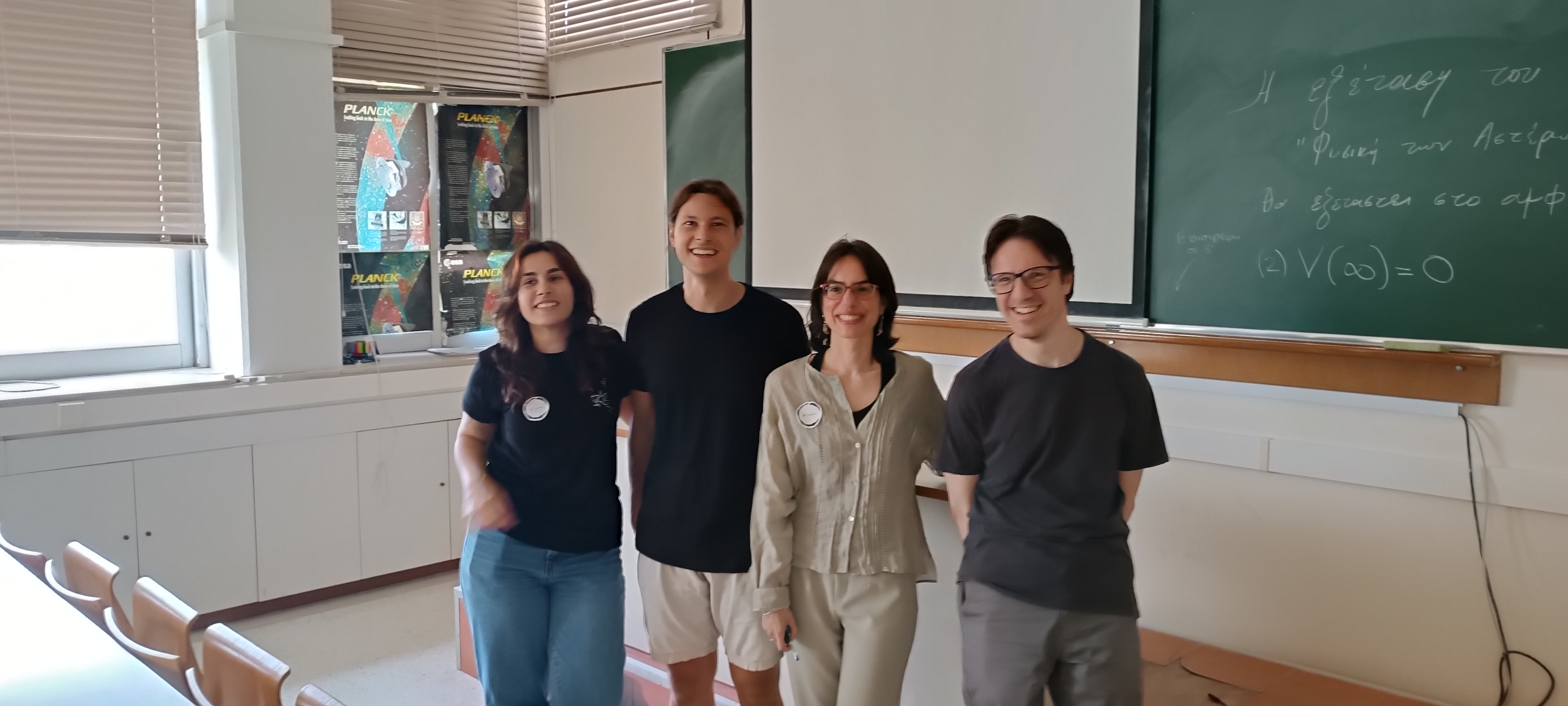




 Maria Petropoulou