Note. Abstract abridged from the MSc diploma thesis of Margaritis Chatzis.
Abstract. Blazars are intrinsically time-variable broadband sources of electromagnetic radiation. While modeling their time-average spectral energy distribution (SED) can be informative about the average physical conditions in the blazar radiation zone, the time domain of blazar emission models has not been adequately explored, especially those invoking the presence of relativistic protons (hadrons) in the jets.
In this project we make a parametric study of blazar variability in the context of single-zone leptohadronic models, and search for those parameter combinations that imprint hadronic signatures on the SED during flaring epochs. Using synthetic gamma-ray light curves, we motivate the generation of time series for key model parameters: the particle energy injection rate, the magnetic field strength, and power law index of accelerated particles.
For this project we choose the TeV blazar Mrk 501 as our test case, as it has been the study ground for extensive investigations during individual flaring events. Using the code LeHaMoC we compute the electromagnetic radiation for a period of several years that contains several flares of interest. We search for energy windows where the hadronic emission may dominate, and provide predictions for very high-energy (VHE, E >100 GeV) spectra and light curves for the upcoming Cherenkov Telescope Array Observatory.
Numerical time-dependent SED models


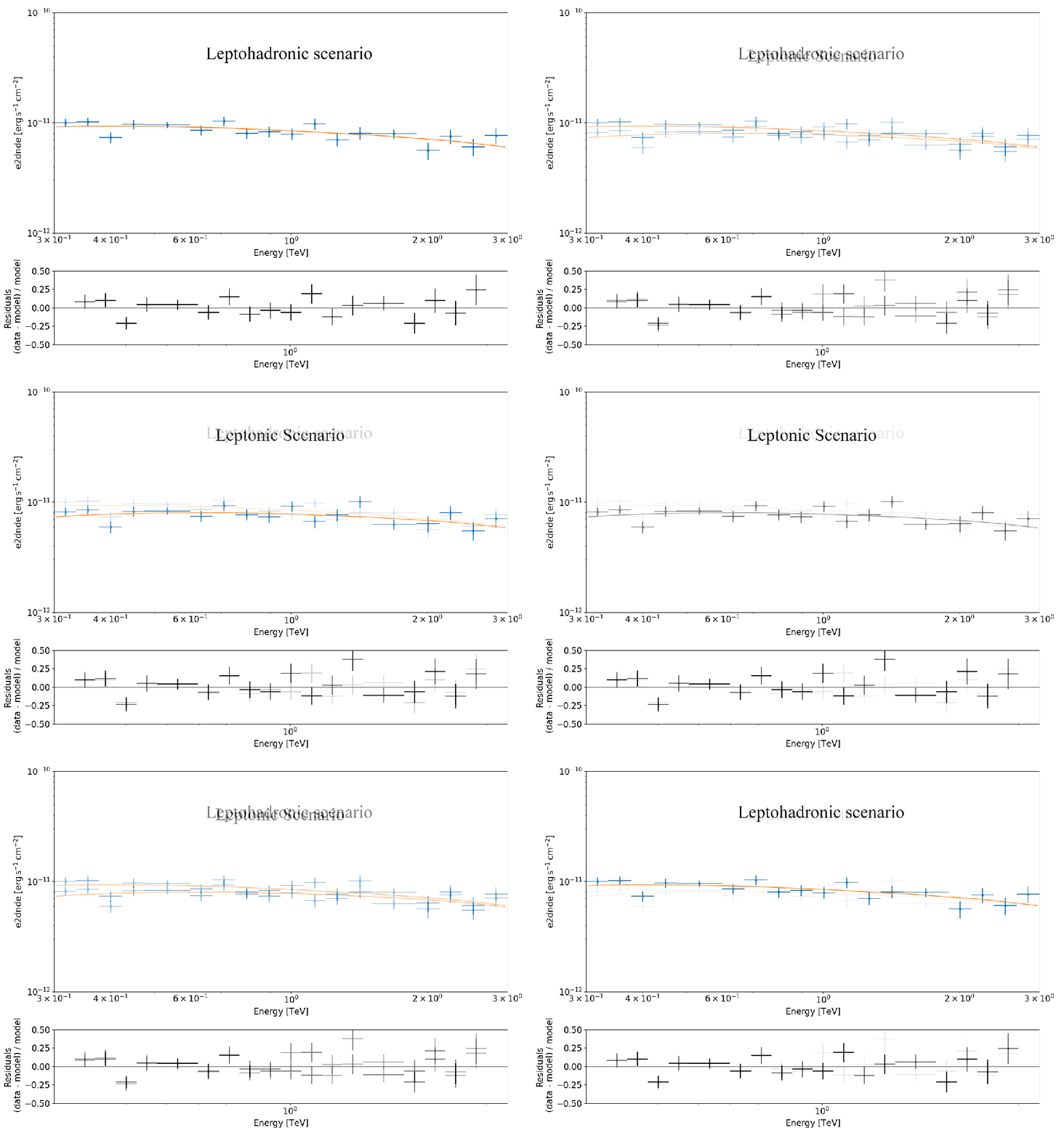
Simulated VHE spectra for CTAO

 Maria Petropoulou